

S1T
For Claude Code and Codex
S1T Harness
Work with AI agents — predictable, controlled and reliable.
Rules
Roles
Skills
Hooks
Commands
Developing with AI agents has many pitfalls. Here are the ones Harness closes
01
Hallucinations
Cites code and facts that do not exist
06
Context overload
All rules at once crowd out the task itself
02
Forgetfulness
After context compaction, loses what was done
07
Documentation drift
Pages fall behind the code the day they are written
03
Guessing instead of asking
Builds the solution on a guessed answer
08
Data leaks
A key in a prompt or chat, traffic outside the VPN
04
“Done” without proof
Declares its own work done and accepts it itself
09
Machine overload
Five sessions run tests at once, memory runs out
05
Silent stop
Drops the work without naming the cause or the next step
10
Collisions
Two agents edit the same thing
S1T Harness · Pitfalls
The answer in five parts
1
Workflow
How a request becomes agreed, finished and verified work
2
Rules and mechanisms
The right rules, guard hooks and network only through the VPN
3
Documentation and development
How records, pages and code stay one truth
4
Secrets and knowledge
How a key reaches the program without passing through the model
5
Machine, sessions and Atlas
How many agents share one machine, and where all the work is visible
S1T Harness · Contents

Part 1
Workflow

Without Harness
The agent writes code on a guess right away, decides itself that it is done, and accepts it itself.

With Harness
Every change goes through the same steps, and done is proven and checked by someone other than the author.
One flow for any change

Without Harness
The agent writes code on a guess right away, and nobody sees which step the work is at

With Harness
The same eight steps for every change; the current step is always visible
1 · Request
human
2 · Clarify
lead
3 · Agreement
lead + human
4 · Development
developer
5 · Review
reviewer
6 · Pages
documentation-author
7 · Human check
human
8 · Acceptance
lead
The human describes what they need
Lead reads docs and code, asks one at a time
Specification, done scenarios, approval
Impact, solution, tests, report
Not the author, a frozen candidate, one verdict
Reconciled with the verified behavior
One checklist file: ticks and comments
Only from OWNER_CHECK and with a final report
S1T Harness · Workflow
Each kind of request has its own path
Without Harness
The agent turns any request into code — even a simple question
With Harness
Lead first decides what kind of request it is, and each kind has its own path
Request
A question that reading answers
Lead answers, no work record
A change to a tracked file
Agreement and a work record, the full flow
A typo or an exact small fix
Short path with a light check
A fact to establish
Research with probes and sources
A resource, secret or Vault fact
Infrastructure work
A new project
Created from a template
A fix to open work
Stays in the same work record
S1T Harness · Workflow
Epics hold Features, Features hold Slices
Without Harness
Large work goes as one lump: nobody knows what is done and what is not
With Harness
Work is a tree: every node has its own acceptance, the Epic accepts the whole
Epic · the overall outcome
Accepting the whole: all Features plus a human check
Feature · one capability
Accepted once its Slices are integrated
Feature
Done whole
Feature · one capability
Accepted once its Slices are integrated
Slice
accepted from REVIEW
Slice
accepted from REVIEW
Slice
accepted from REVIEW
Slice
accepted from REVIEW
Lead accepts every node; a failure in one branch stops only what depends on it
S1T Harness · Workflow
Eight states and the allowed transitions
Without Harness
Work can be declared done, skipping review and the human
With Harness
A program checks transitions: a root is accepted only from OWNER_CHECK
DRAFT
draft
IN_PROGRESS
in work
REVIEW
in review
OWNER_CHECK
waits for the human
ACCEPTED
accepted
REVIEW → ACCEPTED: a child record or a small fix
OWNER_CHECK → IN_PROGRESS: the human returned a correction
BLOCKED
Waits for a named fact, decision or authority; then back to DRAFT or IN_PROGRESS
DEFERRED
Postponed by Lead or the human; then back to DRAFT or IN_PROGRESS
WITHDRAWN
A root closed without delivery, with its reason; goes to the archive
S1T Harness · Workflow
Understand the request first, then build
Without Harness
The agent builds on a guessed answer, or asks what it could have read itself
With Harness
Lead reads first, then asks one question at a time, with a recommendation
1 · Read the docs and the code
2 · Is a material unknown left?
NO → specification and three consents
YES → 3 · one question and its recommendation
4 · The human answers — back to step 2
Can’t be learned by asking → research
yes
no
How deep to clarify depends on uncertainty, consequences and the cost of undoing
S1T Harness · Workflow
Three consents, not one
Without Harness
A “yes” to one question is easy to mistake for consent to everything
With Harness
An answer, an approval and the word “go” are three different consents
1
An answer
covers only that question
2
Approving the specification
the whole specification as written
3
The word “go”
work within the approved scope starts now
status: APPROVED
approved_by: owner
approved_on: 2026-11-11
approval_evidence: "Owner, 2026-11-11: agreement-check.md sections 1 (surfaces), 2 (parts and stories), 3 (definition of done) and 5 (delivery order) ticked; ..."
Approval records who agreed, when and on what basis. Silence and discussion give none of the three consents.
S1T Harness · Workflow
The human approves the API design
surface: POST /orders
kind: http
consumers: web-shop, kitchen
Surface
Was
Will be
Request parameters
items, address
items, address, + promo_code, + idempotency_key
Responses
201 created · 400 invalid
201 created · 400 invalid · + 409 already_placed · + 422 dish_unavailable
Latency p95
300 ms
at most 250 ms
Throughput
200 orders per second
at least 500 orders per second
Without Harness
The human drowns in line-by-line diffs and can’t see what the service actually promises
With Harness
The human approves a surface’s requests, responses and metrics; the internals are the agents’
S1T Harness · Workflow
After approval, Lead decides on its own
Without Harness
The agent pings the human about every trifle, or quietly bends the goal to the code
With Harness
Lead takes the recommended option; only five things go back to the human
A question during the work
Does it change the goal, scope, contract, risk or authority?
NO → Lead takes the recommended option
One line in Decisions by Lead
YES → back to the human
A new goal
Wider scope
A contract change
Risk
Missing authority
no
yes
Every Lead decision is visible to the human at acceptance — no need to dig it out of the code
S1T Harness · Workflow
An assignment: the outcome, not a recipe
Who
Role and level: for example, developer, level 4
What to deliver
The outcome and its done criterion, not a recipe
Where
Working directory, work record and the exact report path
Limits
No commit, push or launching agents; protected paths
Checks
Required checks; the full gate once, on the final candidate
Rules
Links to the rules, not a retelling; a Rules read: line in the report
Something missing from the packet — the agent says so and invents nothing.
Without Harness
The agent gets a recipe in chat and a retelling of the rules, and makes up the rest
With Harness
The packet: who, what, where, limits, checks and rules — six clear parts
S1T Harness · Workflow
What “done” means
1
User stories
What changes in behavior: each human requirement is one story-scenario
“If a dish is out of stock, the order is refused and the kitchen cooks nothing”
+
2
The new works as agreed
Each story has an input, a result, limits, error and recovery — and the proof
proof is a test or a probe, not the agent’s word
+
3
The old still works
An impact table: every surface touched and its consumers
result: “unchanged” or “as in the Interface”, each with its proof
“Code written” and “tests green” are not on this list.
Without Harness
“Tests green” says nothing about what the human asked for, or whether the old broke
With Harness
Done means changed stories, proven new behavior and checked old behavior
S1T Harness · Workflow
An unticked item blocks acceptance
Without Harness
The agent declares “done” itself — and nobody checks it against the agreement
With Harness
Acceptance reads the record: an open item or no result is refused with the reasons
$ s1t-harness docs work accept $S
project shop (/tmp/.../shop)
refused: the change adds 3 check findings: $S:1: missing required section `## Result and evidence` for `ACCEPTED`; $S:2: accepted work record has no inbound maintained-document link; $S:22: accepted record has an unticked DoD box;
next: fix them and rerun; s1t-harness docs work accept --json lists every finding
$ s1t-harness docs work tick $S 1
ok: tick $S, 1 file changed
$ s1t-harness docs work section $S "Result and evidence" ...
ok: section $S, 1 file changed
$ s1t-harness docs work accept $S
ok: accept docs/archive/work/slices/2026-11-11-114020Z-count-each-discount-once/slice.md, 6 files changed
$
S1T Harness · Workflow
The agent never accepts its own work
Without Harness
The author checks against its own reading — and the mistake passes its own tests
With Harness
Someone else checks, on a frozen candidate; the same pair fixes
Author: candidate and final report
Freeze: one commit and its inputs
Reviewer — not the author: reads the agreement and code itself
One verdict
and the number of blockers
NO_BLOCKERS
→ on down the flow
CHANGES_REQUESTED: the same author fixes, the same reviewer checks the fix
The reviewer changes nothing
Writes only its report; probes run in a separate copy, not in the candidate
Second lens — simplifier
Reuse, simplification, needless abstraction
S1T Harness · Workflow
Five model levels
| Level | Claude Code | Codex | Default roles |
|---|---|---|---|
| 1 | claude-haiku-5-5 xhigh | gpt-6-luna high | assigned by Lead |
| 2 | claude-sonnet-5-5 medium | gpt-6-luna xhigh | mechanical-implementer |
| 3 | claude-sonnet-5-5 high | gpt-6.1-sol medium | assigned by Lead |
| 4 | claude-opus-5-5 medium | gpt-6.1-sol high | developer, documentation-author, infra-operator, researcher |
| 5 | claude-opus-5-5 high | gpt-6-astra medium | lead, reviewer, simplifier |
The level follows how non-obvious the task is, not how important. The human can pin a level or a model; an agent never lowers its own level.
Without Harness
A strong model wastes its limit on easy work, a cheap one fails the hard work
With Harness
The level follows how non-obvious the task is; an agent can’t lower it
S1T Harness · Workflow
Each agent has one client
Without Harness
Agents launch agents, and nobody controls the chain any more
With Harness
Only Lead assigns work; each executor has one client
Human
Lead
developer
development
reviewer
independent review
documentation-author
pages
researcher
research
infra-operator
infrastructure
simplifier
second lens
mechanical-implementer
mechanical work
An agent never launches agents
Only Lead assigns work and launches agents
One client
Each executor has one client and one reader of its report
The assignment is a packet
The outcome and the evidence, not a recipe
S1T Harness · Workflow
Parallel lines without collisions
Without Harness
Two agents in one repository overwrite each other’s work
With Harness
Independent lines run in parallel: each with its own branch, worktree and files
Feature A · its own branch, worktree and files
Slice B · its own branch, worktree and files
main branch
Lead merges
and removes the clean worktree
Separate files
Each line’s code, tests and pages are named before launch
One writer
For a shared contract, lock file and configuration
A frozen seam
The specification’s interfaces don’t change
S1T Harness · Workflow
Facts apart from guesses
The goal first
Which question the research answers
What exists first
Docs, code and the Vault — before outside sources
Probes, not guesses
Behavior is checked by experiment, not by the model’s memory
Dated sources
Every source is read and saved to a file
NOT_ESTABLISHED
What isn’t proven is named so, not passed off as fact
Without Harness
The model quotes a page it never opened and passes a guess off as fact
With Harness
Every source is saved to a file; an unavailable one is named unavailable
$ s1t-harness read --output SCRATCH/research1 https://example.com https://example.com/no-such-page
{"schema": "harness-sources/1",
"index": "SCRATCH/research1/index.json",
"sources": [
{"position": 1, "source": "https://example.com", "outcome": "complete",
"content_path": "SCRATCH/research1/001.md", "detail": ""},
{"position": 2, "source": "https://example.com/no-such-page", "outcome": "unavailable",
"content_path": null, "detail": "source returned HTTP 404"}]}
exit 1
$
S1T Harness · Workflow
The canon: four design axioms
1
Simple to operate
Of two working options — the one easiest to use and easiest to keep running.
2
Special behavior is visible
Exceptions, limits and defaults are named where they apply. Failure is loud: the cause and the next step.
3
Fewest surprises
Same input, same result. One way, one home for a fact, one source for a setting.
4
Fewest axioms
Behavior rests on a few principles, and they are written down.
Without Harness
The agent designs to the model’s taste: differently every time, and with surprises
With Harness
Four written axioms — shared principles of any result
S1T Harness · Workflow
Part 2
Rules and mechanisms
Without Harness
All rules at once crowd out the task, a “don’t” line stops nobody, and traffic leaks past the VPN.
With Harness
Rules load by path, a program stops the dangerous, and the network is open only through the tunnel.
The agent gets exactly the rules it needs
Without Harness
52 rule files in context at once — and no room is left for the task itself
With Harness
A rule loads with the first file of its area; boundaries and the canon always
the agent edits
src/shop/kitchen/domain/order.py
then edits
src/shop/kitchen/adapters/driving/
orders_controller.py
and loads 6 of 52 rule files
s-ddd_python/core.md
s-ddd_python/structure.md
s-ddd_python/domain.md
documentation/docstrings.md
common/development-workflow.md
common/testing.md
and gets 4 more: adapter, security, HTTP
common/security.md
s-ddd_python/adapters.md
s-ddd_python/logging.md
security/http.md
Always loaded: the session boundaries and the canon · The agent lists the rules it read on a Rules read: line
S1T Harness · Rules and mechanisms
A long session doesn’t forget what it is doing
Without Harness
After context compaction, the agent loses who it is, what was agreed and what is proven
With Harness
First restore the role, agreement, stage and evidence — then work
1 · Role — from the assignment packet
2 · Agreement — the root specification
3 · Stage — the work record’s state
4 · Evidence — the reports
Then — from the same place
This order is a rule for every session: long work neither restarts nor continues on a guess.
S1T Harness · Rules and mechanisms
Rule conflicts resolve the same way every time
Eight families:
common
documentation
methodology
security
typescript
rust
s-ddd_python
s-ddd_rust
1 · Project-local rules
win first
2 · Architecture
3 · Language
4 · Common rules
The narrower rule wins, but never weakens security.
Without Harness
Every task retells the requirements, and conflicts are resolved at random
With Harness
Eight rule families and one conflict order; security can’t be weakened
S1T Harness · Rules and mechanisms
Boundaries shared by every agent
Action
Agent
Lead
Read, print or commit secrets
never
never
Read a live .env
never
never
Change the project’s Git history
only reads and stages
a commit per stage
Launch agents
no
under an installed role
push, merge, release, deploy
no
only with its own authority
Green tests are no licence to ship: every step outward needs its own authority.
Without Harness
One agent reads .env, another pushes unasked — each has its own rules
With Harness
One boundary table for every session; each outward step needs its own authority
S1T Harness · Rules and mechanisms
An agent can’t rewrite the project’s history
Without Harness
A “don’t commit” line in the agent’s prompt won’t stop it
With Harness
A hook stops agent Git writes and explains what is allowed
The agent runs a git command
Will it change the project checkout?
YES → refused, with the cause and what is allowed
NO → passes: reading, staging, /tmp
Two more hooks: a commit signed by an agent is refused, and a session older than the Harness version gets a warning
$ git commit -m x # an agent, in the project checkout
"permissionDecision": "deny",
"permissionDecisionReason": "s1t-harness git guard: 'git commit' would change this project checkout. An agent reads Git, uses Git freely in a scratch repository under /tmp and may stage into the index (git add, git rm --cached, git restore --staged); only the lead changes anything else in a project checkout (methodology/git.md). ..."
$ git status # the same agent
(no output, exit 0: allowed)
$ git -C /tmp/.../shop commit -m x # the same agent, a scratch Git
(no output, exit 0: allowed)
[main 8c42aec] x
$
S1T Harness · Rules and mechanisms
Mechanism and rule are told apart explicitly
| Mechanism | What the program stops |
|---|---|
| State transitions | an invalid transition and acceptance not from OWNER_CHECK |
| The REVIEW check | work without a final report with a Result or Verdict line |
| Approved specification | an edit without full replacement and new consent |
| Git guard | agent Git writes in the project checkout |
| Commit guard | a commit signed by an agent |
| Page guard | a direct edit of a page a command owns |
| Session freshness | work on outdated rules — with a warning |
Where there is no program, that is said plainly: for example, handing work to another folder is held by a skill rule, not a mechanism.
Without Harness
A rule written as text feels like protection, though nobody checks it
With Harness
Every mechanism is named with its limit — no false sense of safety
S1T Harness · Rules and mechanisms
Egress: traffic only through the chosen tunnel
Without Harness
The session dropped off the VPN and keeps going online from an open address
With Harness
Egress lets the chosen apps’ packets out only through the chosen tunnel
Claude Code
Codex
Any application
egress
each app has its profile
Chosen tunnel
VPN
Network
outside
Past the tunnel
packet refused
The tunnel is down — a new connection fails at once, and nothing gets out. It works for any application, not only for agents.
S1T Harness · Rules and mechanisms
Part 3
Documentation and development — one system
Without Harness
Pages drift from the code the day they are written, and the work state lives in the agent’s memory and in chat.
With Harness
Development follows the records and pages and updates them in the same work.
Six links of one cycle
Without Harness
Pages lag the code, and the work state lives in memory and in chat
With Harness
Records, specification, code, reports, pages and checks — one cycle
One system
development follows it and updates it
Work record
home of the state, the after graph
Specification
agreement and done
Development
reads docs before code
Agent reports
evidence, never edited
Pages
reconciled with behavior
Checks
docs check and docs audit
S1T Harness · Documentation and development
One tree: where to look and where to write
docs/
project.toml
annotation.md what is where; Contents written by the CLI
GLOSSARY.md terms the whole project shares
architecture/ adr/ external/ infra/
work/ open work records
shop/ one repository
annotation.md
shop/ one service
service.toml
annotation.md Axioms of the service
stories/ infra/ architecture.md
domain/example/ contract.md, lifecycle/
One folder per level
Project, repository, service, context; each page kind at its own level
An annotation opens the folder
A human writes the Description, only the command writes Contents
Axioms
Principles of the project, service and context; an empty section shows in docs check
Without Harness
The agent drops a page next to the code, and the next one never finds it
With Harness
One tree and an annotation in every folder: any agent knows where to look
S1T Harness · Documentation and development
A fact has one home and one order of truth
Who is right when they disagree
1 · Code and tests
2 · Agreement
3 · Contract
4 · Description
A page describes these sources and never overrides them; a mismatch stays visible until it is fixed.
Where a fact lives
| Fact | Home |
|---|---|
| Code, tests, project pages | the project repository |
| Secrets, machines, knowledge wider than a repository | the Vault; the repository holds a pointer |
| Anything someone else needs | never only session memory |
Without Harness
A fact written in two places — after the next change one copy is wrong
With Harness
A fact has one home, and in a dispute code wins, then agreement, then contract
S1T Harness · Documentation and development
One write — one answer
Without Harness
The agent doesn’t know if it worked, and writes again or over someone else’s
With Harness
One line: ok with a revision, or refused with the next command
$ s1t-harness docs glossary create docs/GLOSSARY.md --content-file g.md
project shop (/tmp/.../shop)
ok: create docs/GLOSSARY.md, 2 files changed; observed: sha256:37d6d6e7...
$ s1t-harness docs glossary create docs/GLOSSARY.md --content-file g.md
refused: destination exists; read before editing; next: s1t-harness docs glossary create --help
$ s1t-harness docs glossary create docs/infra/GLOSSARY.md --content-file g.md
refused: path does not belong to glossary; consult docs glossary help; next: s1t-harness docs glossary create --help
$ s1t-harness docs glossary section docs/GLOSSARY.md Orders --append --content-file row.md --observed sha256:37d6d6e7...
refused: stale --observed for docs/GLOSSARY.md; current revision sha256:3654929e...; next: s1t-harness docs glossary read docs/GLOSSARY.md
$
S1T Harness · Documentation and development
A program finds documentation errors
$ s1t-harness docs check
project shop (/tmp/.../shop)
CHECK -- 1 failures, 0 orphan advisories, 35 links
docs/GLOSSARY.md:13: relative link target does not exist: `payments.md` [documentation/common.md]
ADVISORY -- 38 findings on 37 pages: coverage 4, form 0, template 34; 0 waived
docs/adr/0000-example.md: template 1
exit 1
docs check
Broken links, page form, levels, templates and length budgets: 120 lines of prose, 400 in all
docs audit
Semantic checks A1–A6 against the code: identifiers, paths, routes, error codes
Without Harness
A reader spots the broken link and the stale page — when it is already too late
With Harness
docs check and docs audit find them by program, before acceptance
S1T Harness · Documentation and development

Part 4
Secrets and knowledge
Without Harness
A key pasted into chat stays in the prompt, transcript and logs forever.
With Harness
Secrets live in KeePassXC and reach the program without passing through the model; knowledge lives in the Vault.
The model sees an address, not a value
What the model sees
Book address
l1/group/title
Command
secrets issue
What never passes through the model
Private package
answer.md and values beside it, 0600
Program
reads the value and hands it to the library
Secrets live in KeePassXC databases. secrets issue hands out a private package: answer.md describes the secret, the values sit in files beside it with mode 0600. Only a trusted program reads a value and passes it straight to the library.
Without Harness
A token pasted into chat stays in the transcript, logs and history
With Harness
The model sees only the book address; the value goes from the package straight to the program
S1T Harness · Secrets and knowledge
L1 for agents, L2 for the owner only
Without Harness
The agent takes a similar secret, or the most valuable key since it has access
With Harness
Agents get only L1 and only by exact address; the owner opens L2 personally
Two separate KeePassXC databases
Agents
on the owner’s machine
Owner
human
L1 · for agents
unlocked in the secret store; agents on the machine get books by exact address
L2 · owner only
the owner opens it personally and works with it by hand
by exact address l1/…
never
by hand
S1T Harness · Secrets and knowledge
A refusal is no reason to look for a way around
Without Harness
Refused, the agent looks for the key in .env, in history or in chat
With Harness
A refusal names its class and next step, and never permits a workaround
Secrets refusal
Address
Rediscover through metadata and fix the address; never a similar name
Temporarily busy
Retry the whole batch later, a few times at most
Owner action
Report the paths and reasons to the owner; retry after
Unknown
Report it as a refusal; don’t retry or guess
Never: a refusal doesn’t permit taking the secret from another source
S1T Harness · Secrets and knowledge
Managing secrets without seeing values
$ s1t-harness secrets status
{"schema": "vault-secrets/1", "status": "ok", "databases": [".secrets/l1", ".secrets/l2"], "locked_levels": ["l2"], "pending": false}
Status and sync
secrets status and secrets sync — without a single value
Guardian
Orders books by metadata only; never sees values
Permanent deployment
A separate authorized operation, recorded on the resource card
Secrets are managed without showing them to a model or a report.
Without Harness
To sort out secrets you have to show them to the agent
With Harness
Status, sync and book order — by metadata only, without values
S1T Harness · Secrets and knowledge
Three levels of knowledge
1
Documentation
What the project promises: contracts, decisions, stories, glossary — in the repository next to the code
2
The code itself
How everything is really done; when they disagree, a page doesn’t override the code
3
Vault
What is wider than a repository: machines, people, accounts, decisions and problems
vault ask
vault read
vault save
vault update
vault write
vault operation
vault attach
Saving only appends; changing a fact is a separate command — and that is the owner’s confirmation. A repository holds a pointer, not a copy.
Without Harness
Where is the server, whose account, what was decided last month? The agent guesses
With Harness
The agent reads the right level; knowledge wider than a repository lives in the Vault
S1T Harness · Secrets and knowledge
Part 5
Machine, sessions and Atlas
Without Harness
Five sessions run tests at once, two Leads edit one project, and nobody sees what waits for a decision.
With Harness
Heavy work waits for its memory, sessions see each other, and Atlas shows all the work in one place.
A smart queue for heavy jobs
Without Harness
Five sessions run tests at once, and the machine dies out of memory
With Harness
All heavy agent work goes through the smart queue — the machine doesn’t fall over
tests
builds
containers
background processes
Smart queue
blocking
urgent — at once
normal
waits at most an hour
background
waits at most 4 hours
Machine
each job under its own memory cap; 10% always free
no out of memory
Short ones first
Small, quick jobs don’t queue behind a big one
Wait timeout
A job that reached its limit reserves its memory
Priority on the fly
Any session can raise a waiting job’s importance
S1T Harness · Machine, sessions and Atlas
“Tests passed” — for specific code
Without Harness
“Tests passed” — but on which code, nobody can say any more
With Harness
A receipt ties the exit code to the tree hash; a changed tree is refused
$ s1t-harness heavy run --for SLICE --title 'scratch shop task check' --memory 1G --estimate 1m -- task check
...
heavy: finished 'scratch shop task check' in 5s: exit 0, peak 114M
heavy: receipt: 2fd585e8083c tree 349938a7b500 exit 0
$
Code tree
349938a7b500
+
Exit code
0
Receipt
2fd585e8083c
Tree changed
→ refused
“Tests passed” is proven for specific code, not in general.
S1T Harness · Machine, sessions and Atlas
You can see who is working in which project
$ s1t-harness leads
live leads: 5
claude pid 42236: busy, started 2026-11-10 20:40
folder ~/projects/project-a
project project-a
contact a-blog-lead (Claude session name)
claude pid 3662279: shell, started 2026-11-11 11:33
folder ~/projects/project-b
project project-b
contact b-research-lead (Claude session name)
...
Folder and project
Where each live Claude and Codex session works
Contact
The session name you can hand a task to
Not a Lead — and it says so
codex exec without a live session is not listed
Without Harness
Nobody knows which sessions are running now, or in which projects
With Harness
The leads command shows live Leads: each one’s folder, project and contact
S1T Harness · Machine, sessions and Atlas
Another’s folder — through its Lead
Without Harness
Two sessions edit one project and do the same work twice
With Harness
A session doesn’t write into another’s folder; it hands the task to that project’s live Lead
Session in project A
Lead of project B
1 · Needs a change in project B
2 · leads: who is live in B
3 · Task via the contact
4 · Takes it as its own work
5 · Does it and returns the answer
6 · Gets the answer
7 · Continues its own work
A session never edits another’s folder itself. This is a foreign-folder skill rule, not a mechanism.
S1T Harness · Machine, sessions and Atlas
A new project is strict from the first commit
Without Harness
A new project starts from a hand-made skeleton, with tests and docs “later”
With Harness
One command: a project with documentation, checks and its first commits
$ s1t-harness project create shop --template python
project shop (SCRATCH/shop, new)
created SCRATCH/shop/docs/project.toml
created SCRATCH/shop/docs/work/ (5 files)
created SCRATCH/shop/shop/.gitleaks.toml
created SCRATCH/shop/shop/pyproject.toml
created SCRATCH/shop/shop/src/shop/ (146 files)
...
templates 35 pages, not yet written; s1t-harness docs check lists them
committed SCRATCH/shop/shop f26e7bc Create repository shop
committed SCRATCH/shop 9e0d912 Create project shop
$
$ task check
All checks passed!
145 files already formatted
Success: no issues found in 138 source files
Contracts: 19 kept, 0 broken.
============== 160 passed in 2.52s ==============
Successfully built dist/shop-0.0.0-py3-none-any.whl
$ s1t-harness docs check
CHECK -- 0 failures, 0 orphan advisories, 32 links
ADVISORY -- 39 findings on 38 pages: coverage 4, form 0, template 35; 0 waived
$
S1T Harness · Machine, sessions and Atlas
Strict checks — from the first commit
Without Harness
Checks get switched on “later”, and by then the code already breaks them
With Harness
Ruff, strict mypy, import contracts and tests — from the first commit, in one command
task check
one Taskfile command runs everything
Ruff
linter
All checks passed!
Ruff format
one format
145 files already formatted
mypy strict
strict types
no issues in 138 source files
import-linter
layer direction
19 kept, 0 broken
pytest
tests
160 passed in 2.52s
build
package build
built dist/shop-0.0.0…whl
Strict from day one
Every linter rule, strict types, import contracts
Rust — the compiler
Code that breaks the rules simply doesn’t build
Loosen only with a reason
Every exception carries its reason and goes through review
S1T Harness · Machine, sessions and Atlas
Atlas: all the work in one place
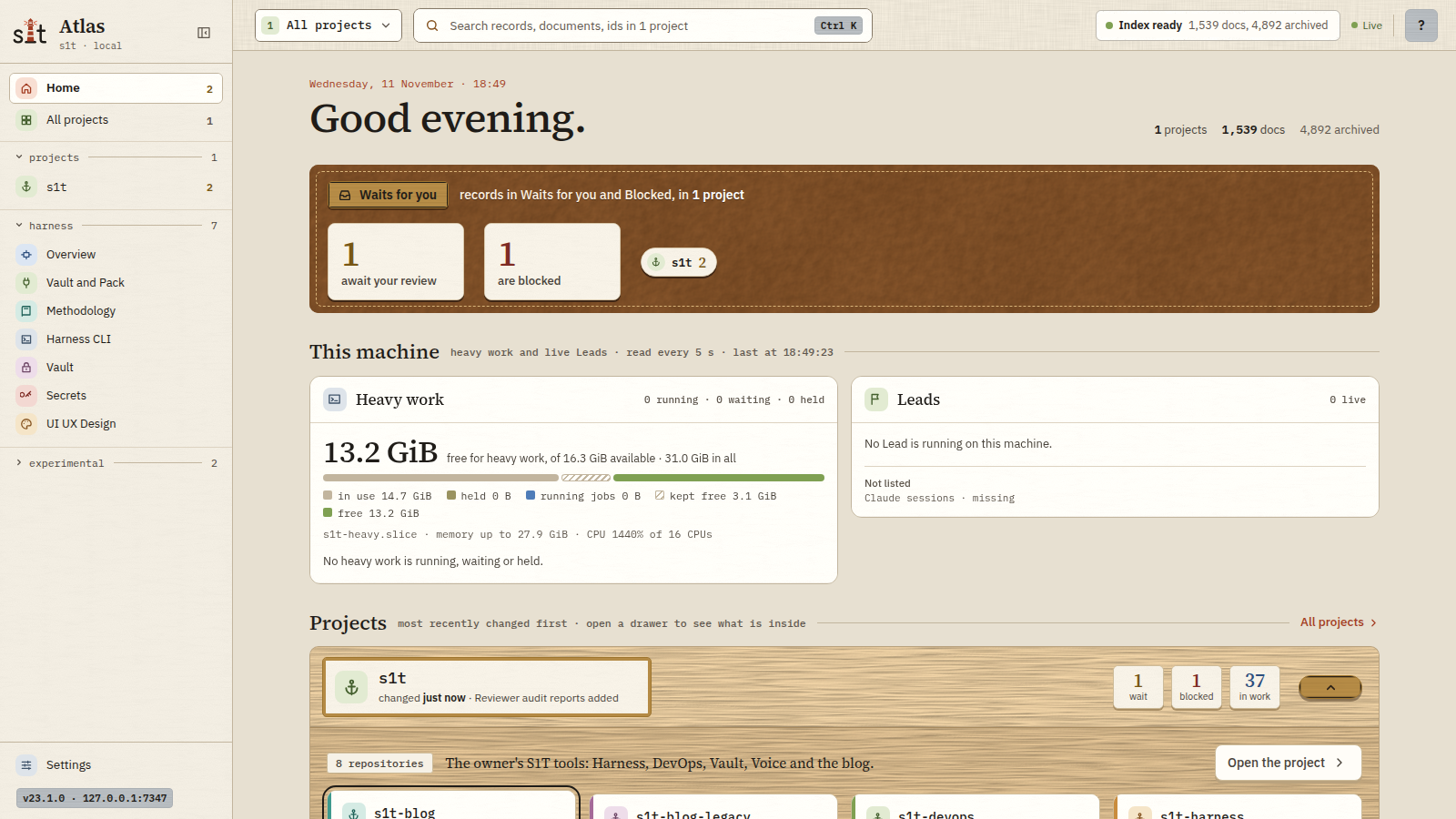
Waits for you
What waits for the human’s review and what is blocked — without opening files
This machine
Free memory for heavy jobs and live Leads
Projects
Every project with its repositories and work counts
Atlas stores nothing itself — it reads the projects’ records.
Without Harness
The records are right, but nobody reads hundreds of files across repositories
With Harness
Atlas reads every project’s records and shows what waits for a decision
S1T Harness · Machine, sessions and Atlas
Task graph, documentation and how Harness works
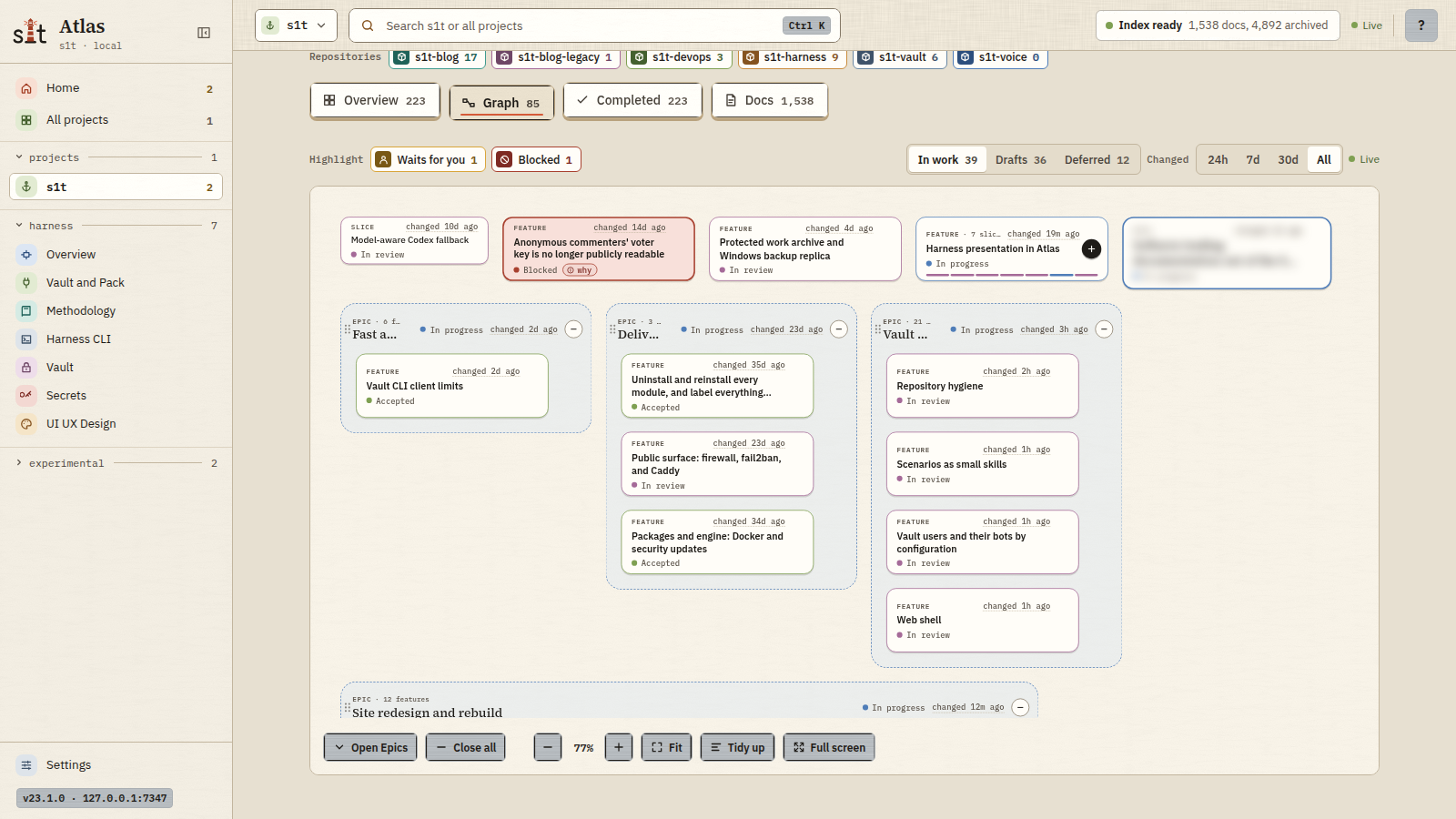
Task graph
Order by after, accepted work and the age of changes
Reader and Search
Any project page and search across all projects
Live updates
A file change shows within a fraction of a second
How Harness works
Methodology, every CLI command, Vault, Secrets
S1T Harness · Machine, sessions and Atlas
And more — what works without reminders
One install, two runtimes
One package in Claude Code and Codex; the version changes by one pointer switch and rolls back
Git by stage
Only Lead commits, one commit per stage; push, merge and deploy each need their own authority
Infrastructure by level
Access low, medium or high; a plan and rollback before a change; a resource card and journal
Metrics from data
Delivery from Git, work records and session logs; a weekly digest in the Vault
A method failure becomes work
A problem in the process itself is recorded as a Vault note and isn’t lost
Skill catalog
22 skills: one technique, one skill; you can see which are used
Usage limits
Claude and Codex stop at the budget threshold the human named
One look for interfaces
The S1T Japandi 2.0 design system; a human picks the style, not the agent
S1T Harness · Machine, sessions and Atlas
Without Harness and with Harness
Pitfall
Without Harness
With Harness
Hallucinations
Cites code and sources it never opened
Reads before writing; the unproven is marked NOT_ESTABLISHED
Forgetfulness
After a restart, doesn’t know what is done and what is next
State lives in the work record, not in session memory
Guessing instead of asking
Builds on a guessed answer
Clarifying with a recommendation, and an approved specification
“Done” without proof
Declares done itself and accepts it itself
Done scenarios, review by someone else, acceptance from OWNER_CHECK
Documentation drift
Pages lag the code
One fact, one home; page reconciliation, docs check and docs audit
Data leaks
A key in a prompt or chat, traffic outside the VPN
The model sees only an address; network only through the tunnel
Machine overload
Sessions exhaust memory and edit the same thing
Heavy work waits for its memory; tasks go to the project’s Lead

S1T
Predictable. Controlled. Reliable.
S1T Harness — one method for working with AI agents in Claude Code and Codex.